Two Forms of Exposure
Place Egon Schiele alongside Claude Monet, and the distinction sharpens.
Schiele’s work remains formally significant. But it does not fully settle.
It moves between admiration and discomfort, between recognition and ethical tension. Value shifts in the reading, not the object.
Value shifts in the reading, not the object.
As that reading recalibrates, liquidity can narrow abruptly.
Reading is not neutral.
It is held, repeated, stabilized over time.
What appears as value is often the persistence of a way of seeing.
And risk emerges when that way of seeing begins to loosen.
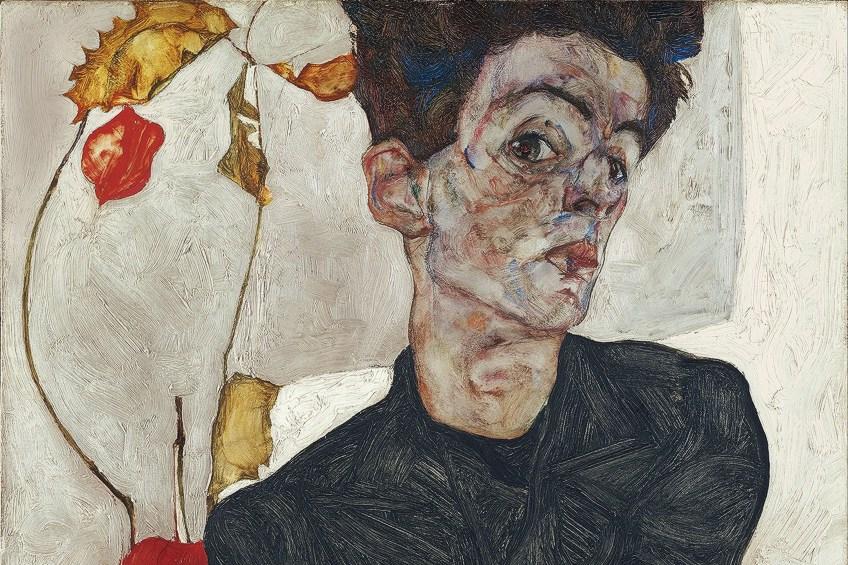
Egon Schiele, Self-Portrait (c. 1910), watercolor and gouache on paper. Public domain.
Monet sits elsewhere.
His work has been absorbed into an institutional continuum - museums, scholarship, exhibition histories, and a long record of transactions.
Interpretation remains. But it no longer destabilizes value. It has been processed, repeated, held in place.
Institutions do not remove risk. They convert it.
Institutional absorption does not remove risk. It converts it.
Meaning is relocated into a condition of exchange.
The work remains legible, even as value fluctuates around it.

Claude Monet, Water Lilies (1914–1926), Musée de l’Orangerie, Paris. Public domain / museum documentation.
One moves with interpretation.
The other holds within structure.
When Value Moves
These exposures do not respond to time in the same way.
With Schiele, shifts in discourse, ethical, curatorial, and cultural, alter demand directly. The market moves with meaning.
With Monet, that layer is largely settled. What circulates instead is capital: liquidity, wealth concentration, collector confidence. The work holds its place, even as prices move around it.
The distinction is not inherent to the work, but to the position from which it is held.
To hold a Monet is to place value within a structure already sustained by time.
Risk has been redistributed across institutions, histories of exhibition, and repeated recognition.
To hold a Schiele is different.
The work does not arrive with the same continuity.
Its value depends on whether its tensions, ethical, cultural, perceptual, can continue to hold.
This is not a difference in object, but in the condition under which value persists.
Risk is not simply exposure to fluctuation.
It is the requirement that value be actively sustained where no structure yet secures it.
Stability is not found.
It is produced through repetition, alignment, and time.
What appears stable is often the residue of that production.

The Illusion of Balance
Placing both together suggests diversification. Two different exposures, two different logics. Under normal conditions, that separation holds.
But only up to a point.
When conditions tighten, when liquidity recedes, when confidence withdraws, distinctions begin to compress.
What once moved separately starts to move together.
Under stress, the illusion of independence collapses. Diversification does not hedge, it obscures.
Risk in art is layered - interpretive, institutional, economic. Some layers offset. Others reinforce under pressure.
Collecting is not the removal of risk, but the positioning of it.
What appears diversified may, under stress, reveal a deeper alignment.
— Dao Nguyen Anh