Looking is a political act. Presence is not given. It is constructed, mediated, and sometimes refused.
Women in art are not subjects. They are positions within a structure of seeing.
Figure 1. Vilhelm Hammershøi, Interior with Young Woman Seen from the Back, 1904. Oil on canvas. Randers Museum of Art.
A Mediated Presence
It is constructed, mediated, and continuously negotiated within systems of representation that determine not only how women are seen, but whether they are allowed to exist as subjects at all.
Rather than approaching women in art as a stable iconographic category, this essay proposes a different lens: that the female figure operates as a site where the politics of visibility unfolds.
Drawing on Laura Mulvey’s concept of the male gaze, particularly the condition of to-be-looked-at-ness, the female figure in painting can be understood as structurally oriented toward visual consumption. Her presence is not simply depicted. It is produced as something to be seen.
Across key moments in Western art, this orientation does not resolve into emancipation. Instead, it reveals a set of tensions between intimacy and control, visibility and containment, and presence and withdrawal.
The Architecture of Intimacy
In Girl with a Pearl Earring, intimacy is constructed through light.
Vermeer’s chiaroscuro isolates the figure against a dark ground, collapsing space and directing attention toward the face. Light does not merely reveal; it organizes visibility.
The gaze appears direct. Yet it remains suspended within to-be-looked-at-ness, a condition where visibility is structured without granting reciprocal agency.
Her presence is not simply depicted. It is produced as something to be seen.
Figure 2. Johannes Vermeer, Girl with a Pearl Earring, c. 1665. Oil on canvas. Mauritshuis, The Hague.
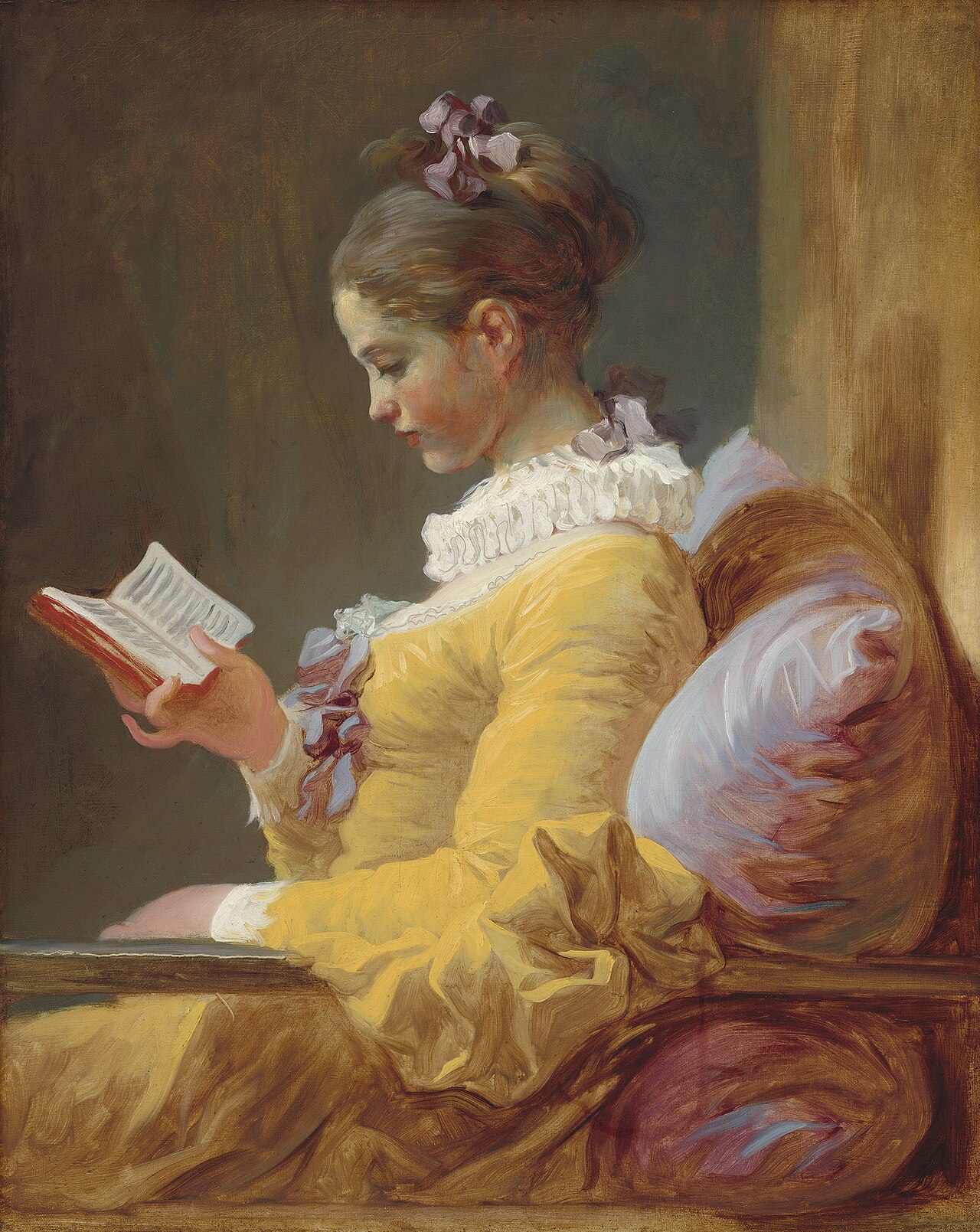
In The Reader, interiority appears as a visual effect.
The figure, absorbed in reading, seems withdrawn. But this withdrawal is composed through color, gesture, and balance.
What emerges is not private experience, but the aestheticization of privacy, interiority rendered visible, and therefore consumable.
Visibility is not neutral.
Figure 3. Jean-Honoré Fragonard, The Reader, c. 1770–1772. Oil on canvas. National Gallery of Art, Washington, D.C
Dissolution and Visual Materiality
With Impressionism, the female figure enters modern visibility but not as an autonomous subject.
In the works of Pierre-Auguste Renoir, women appear within urban leisure: cafés, boulevards, gatherings.
Historically, these spaces were structured by constraint. Women were visible in the city, but primarily within zones coded as domestic or spectacular.
Their presence expands. Their agency does not.
Formally, this condition is articulated through the dissolution of contour.
The loosening of line does more than register perception. It redistributes the figure into the surface of vision. It repositions the female body as visual material, integrated into the surface of modern life, absorbed into the rhythms of spectacle and consumption.
Figure 4. Pierre-Auguste Renoir, Les Parapluies, c. 1881–1886. Oil on canvas. National Gallery, London.
In Claude Monet, this process intensifies.
Form disperses into light. The figure becomes atmospheric.
She is no longer fixed as object, but neither is she constituted as subject.
She is seen as part of what is seen.
Figure 5. Claude Monet, Woman with a Parasol – Madame Monet and Her Son, 1875. Oil on canvas. National Gallery of Art, Washington, D.C.
The Aestheticization of Passivity
Figure 6. John Everett Millais, Ophelia, 1851–1852. Oil on canvas. Tate Britain, London.
In Ophelia, visibility condenses into a total image.
The figure is no longer placed within a scene. She becomes its center and its limit.
Millais’ precise rendering suspends time. The body floats, intact, untouched by decay.
Here, to-be-looked-at-ness reaches its most complete form.
Ophelia is entirely available to the gaze. Her passivity is aestheticized. Her death is stabilized into beauty.
She functions not as a subject, but as a perfected image of stillness.
Withdrawal and Agency through Negation
Figure 7. Vilhelm Hammershøi, Interior with Young Woman Seen from the Back, 1904. Oil on canvas. Randers Museum of Art.
In the interiors of Vilhelm Hammershøi, the structure shifts.
The woman turns away. She does not perform for visibility.
She does not meet the gaze. She does not complete the image. She does not resolve into narrative.
Formally, this is reinforced through muted palettes, restrained tonal shifts, and architectural compositions that organize space without granting access.
What emerges is not absence, but a refusal of visual availability.
This refusal can be understood as a form of agency through negation.
The subject does not assert herself through visibility, but through the withdrawal from it.
She remains present, but inaccessible.
Fractures of visibility
To study women in art is not to define an image.
It is to trace the conditions under which visibility is produced, and where it begins to fracture.
Across these works, the female figure does not move toward a stable form of subjecthood. Instead, she marks the limits of representation itself.
Visibility intensifies. It disperses. It is refused.
These fractures do not resolve the image. They open it.
To recognize them is to see how women have been seen,and to begin releasing them from the structures that made them visible.
And in doing so, to see where visibility itself begins to loosen.
— Dao Nguyen Anh
Keywords
Female Subjectivity; The Male Gaze; To-be-looked-at-ness; Visual Materiality; Politics of Visibility; Feminist Art History; Presence and Absence; Pictorial Representation